
Antenna Polarization and Orientation in Building Automation
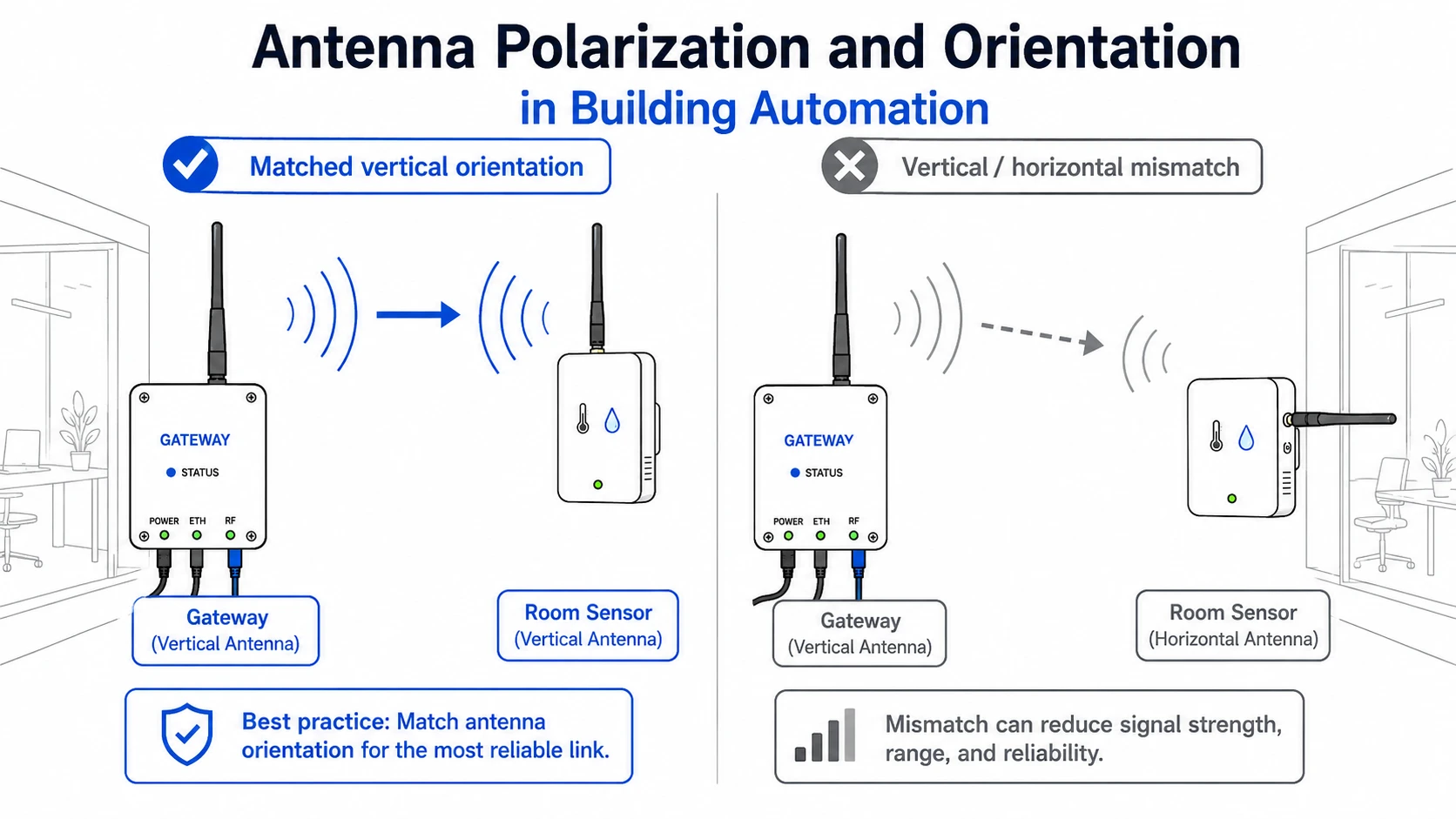
Antenna polarization and orientation can change received signal strength even when distance and radio settings stay the same. Many simple antennas are linearly polarized.
For broader context, see the wireless building automation guide.
Matched orientation is the safe starting point
When both ends use simple linear antennas, keep them in the same orientation when possible. A common arrangement is a vertical whip at the gateway and a vertical antenna at the sensor.
Internal antennas need manufacturer guidance
Compact wall devices often hide the antenna inside the enclosure. Follow the intended mounting orientation and avoid placing the enclosure directly against metal.
Fast troubleshooting check
Confirm the correct frequency band, connector condition and antenna orientation. Rotate or reposition the antenna when possible, then compare RSSI, SNR and packet loss before and after the change.
Practical engineering check
Use the concept as part of a measured installation rather than as an isolated rule. Confirm the device and antenna are intended for the correct frequency region, inspect the final mounting position, and establish a baseline from the real endpoint location. Change one variable at a time so the effect of antenna position, height, metal, cable loss or nearby equipment remains visible in the results.
Record RSSI, SNR and packet delivery where the protocol exposes them. Repeat the test from the building’s difficult locations with doors closed and normal equipment running. If a small placement change creates a large improvement, solve the physical RF path before increasing transmit power or adding unnecessary hardware.
Common mistakes to avoid
- Treating a datasheet range as a guaranteed indoor distance.
- Testing only beside the gateway instead of from the worst-case room.
- Leaving an antenna inside or directly against a metal enclosure.
- Judging reliability from one RSSI value or one successful packet.
- Changing several variables at once and losing the ability to identify the real cause.